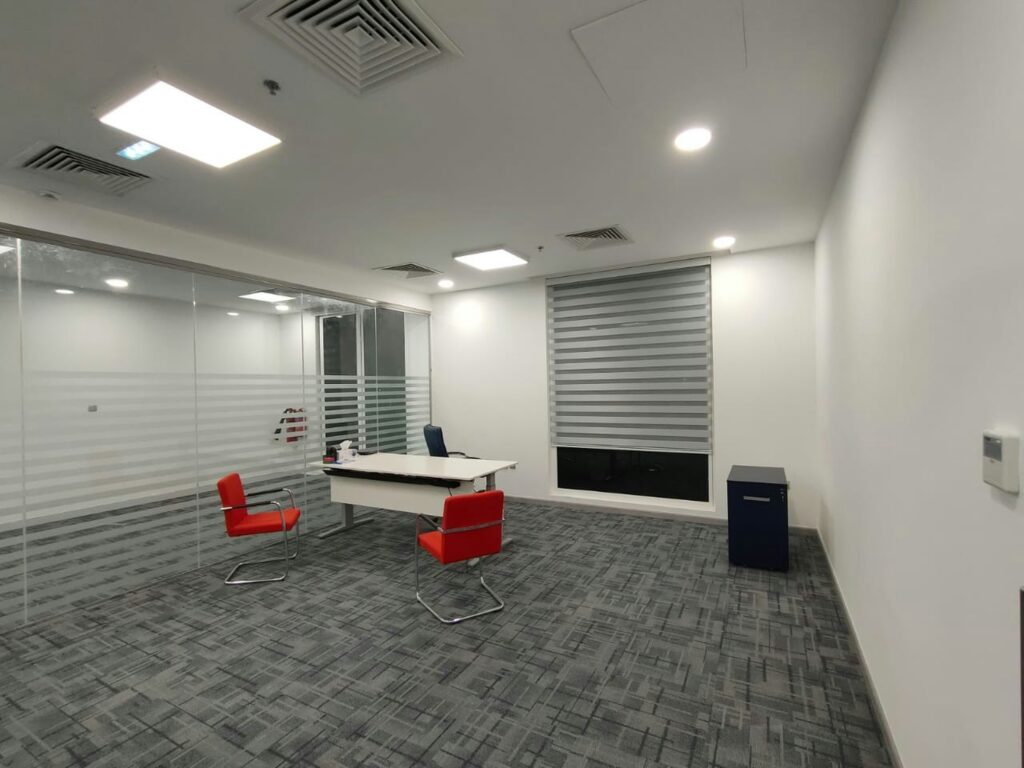
Most office fit-out projects don’t fail at demolition or drywall. They stall in the last three weeks, at handover, when a snag list that should have had forty items has three hundred — and the move-in date that HR has already emailed to 400 people quietly slips. Snagging is the least glamorous stage of a fit-out and the one that most reliably decides whether you occupy on schedule.
Here’s how to run the handover phase of an office fit-out in India so the last mile doesn’t eat your timeline.
Snagging Is Not a Punch List You Write at the End
The single most common mistake is treating snagging as a one-off inspection that happens after the contractor says “we’re done.” By then, defects are buried. A chipped skirting is visible; a chilled-water line that was never pressure-tested behind a false ceiling is not.
Effective snagging runs in three passes:
- Pre-closure snagging — before ceilings are closed and boxing is sealed. This is where MEP defects are cheap to fix. Once the grid goes up, every correction costs a day and a ceiling tile.
- Pre-handover snagging — after finishes, before furniture. Walls, joinery, flooring, paint, glazing, door hardware, light levels.
- Post-furniture snagging — after workstations land, when damage from installation traffic shows up and power and data at desk level can finally be tested live.
If your programme only budgets for the second pass, you have already lost the first one. Build all three into the schedule from day one — our week-by-week fit-out timeline shows where each pass belongs.
The Office Fit-Out Snagging Checklist
MEP and services
- HVAC: air balancing report submitted, diffuser throw checked against the seating layout, condensate drains sloped and tested, thermostat zoning matched to the actual seating plan rather than the day-one drawing.
- Electrical: earth continuity and insulation resistance test reports, DB schedules labelled and laminated, emergency lighting tested on battery for its full rated duration.
- Fire: sprinkler heads centred in tiles and unobstructed by ducting, detectors tested zone by zone, PA audibility checked inside enclosed rooms with the door shut.
- Data: every outlet tested and certified, patch panel labelling matched to floor plan numbering rather than the cabling vendor’s internal codes.
- Plumbing: pressure test certificates, water flow at every fixture, no dead legs in the pantry supply line.
Finishes and joinery
- Paint: check under raking light, not overhead light. Roller marks and patch repairs are invisible at noon and obvious at 6pm.
- Flooring: level tolerance across transitions, no hollow tiles on a tap test, carpet seams kept out of primary sightlines.
- Glazing and partitions: film alignment, manifestation at the correct height, no silicone smear, doors closing without binding.
- Joinery: drawer and shutter alignment, soft-close working, edge banding intact, wire management cut-outs actually usable once a monitor arm is fitted.
- Ceiling: grid level, tiles seated, no gaps at the perimeter, access panels wherever services need reaching.
Acoustics, light and comfort
- Meeting room speech privacy tested with a real conversation, not a spec sheet. Most complaints in the first month are acoustic.
- Lux levels measured at desk height against the design intent, and glare checked from seated eye level.
- Noise from AHUs, VRF units and pantry equipment measured during working hours, not at 9pm when the building is empty.
The Documents That Matter More Than the Snag List
A snag list closes out. Documentation is what you live with for the next five years. Before releasing the final payment, insist on:
- As-built drawings — architectural, electrical, HVAC, plumbing, fire and data, reflecting what was actually installed. Not the tender set with a new title block.
- Testing and commissioning certificates for every system, signed and dated.
- Warranty documents with start dates tied to handover, not to the date the material was invoiced.
- O&M manuals and a spares handover — extra ceiling tiles, carpet tiles and touch-up paint in labelled tins, matched to batch numbers.
- Statutory clearances — fire NOC, occupancy documentation and landlord sign-offs. These have their own lead times, which is why we covered the NOCs that quietly add weeks to a project separately.
- Vendor and AMC contact list — one page, one owner per system.
Hold Back the Right Amount, and Define What Closed Means
Retention is the only real leverage you have after occupation. A typical structure holds back 5–10% of contract value and releases it in two tranches: part at snag closure, the balance at the end of the defects liability period, commonly twelve months. Two clauses do the heavy lifting.
- A defined closure standard: a snag is closed when the client representative signs it off, not when the contractor marks it done in the tracker.
- A defects liability period covering a full seasonal cycle, so monsoon leaks and peak-summer HVAC performance are still the contractor’s problem.
Track snags in a shared log with a photo, a location, an owner and a date — not over WhatsApp. When the same defect appears in three places, that is not three snags, it is a workmanship issue worth escalating before the rest of the floor is built the same way.
Why the Delivery Model Changes the Snag Count
Snag volume is largely a function of coordination. Where design, MEP and execution sit with separate parties, defects concentrate at the interfaces between them — the ceiling void, the wall build-up, the desk power route — because nobody owns them end to end. Single-point delivery removes most of that interface risk, which is one of the practical arguments in our design and build versus traditional contracting comparison, and a good reason to bring MEP consultancy in early rather than after the layout is frozen.
Budget for handover the way you budget for everything else: it belongs in the programme and in the number, alongside the line items in our fit-out cost per square foot guide.
Planning a fit-out and want handover built into the schedule from week one? Talk to the AirBrick Infra team about your design and build requirement.